
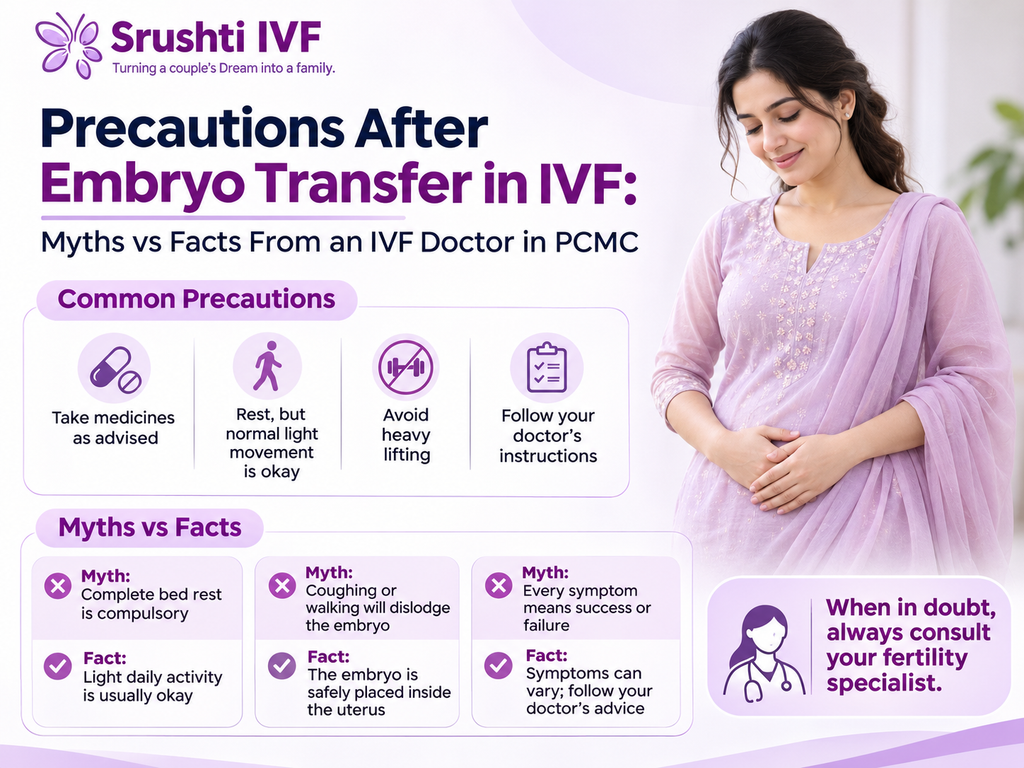
The embryo transfer is done. The procedure took only a few minutes, and now comes the part nobody prepares you for: the waiting. In these two weeks, almost every patient asks the same things. Should I lie down? Can I climb stairs? Is this cramp normal? Did I eat something I should not have?
If you are looking for an IVF doctor in PCMC to explain what is safe after your transfer, this guide is for you. These are the questions patients ask us after almost every transfer, and the honest answers are simpler than the advice that arrives from relatives and WhatsApp groups.
Quick answer: After an embryo transfer you can walk, climb stairs, shower, eat normally and return to light work. Strict bed rest does not improve success. Take progesterone and other medicines on time. Avoid heavy lifting, hot baths, smoking, alcohol and self-prescribed remedies. Test only on the date your doctor gives, usually about 12 to 14 days after transfer.
What happens inside your body after an embryo transfer?
After transfer, the embryo settles against the uterine lining and begins to implant, usually within a few days. Nothing you do in daily life can pull it out. What you can control is supporting the lining with your medicines and keeping your body calm and comfortable.
A blastocyst, the embryo stage most often transferred, measures only about 0.1 to 0.2 mm. It is placed in the uterine cavity, where the front and back walls rest against each other and hold it in place. Walking, coughing, sneezing or using the toilet does not move it. The transfer is the final step of IVF treatment in PCMC, but implantation itself happens quietly over the next few days.
Once the embryo implants, the body starts producing hCG, the pregnancy hormone. This is why a blood test needs about two weeks to give a reliable answer, and why early symptoms tell you very little.
Do you need bed rest after embryo transfer?
No. Bed rest does not improve pregnancy rates. Resting for 15 to 30 minutes at the clinic is enough. After that you can go home and move about normally. Long hours in bed add stiffness and worry, with no proven benefit.
Studies comparing patients who rested with those who got up straight away have not found a better outcome for the resting group. Many habits that families insist on come from old advice, not evidence. Here is how the common beliefs hold up.
| Common belief | What the evidence and experience show |
| The embryo will fall out if I walk or climb stairs. | It cannot. The uterus holds the embryo gently in place, and everyday movement does not dislodge it. |
| I should lie flat for 3 days. | Strict bed rest has not been shown to help. Light movement keeps circulation normal and often keeps you calmer. |
| Going to work will harm implantation. | There is no evidence that staying off work improves results. Avoid heavy physical work, but desk work is fine. |
| No symptoms means the cycle has failed. | Most symptoms come from hormone medicines, so having none says nothing about the result. The blood test is the only reliable answer. |
| Every precaution I skip lowers my chances. | Results depend mainly on embryo quality, the uterine lining and timing, which were settled before the transfer. Guilt over small slips is misplaced. |
What are the dos and don’ts after embryo transfer?
The precautions after embryo transfer that matter most are simple: take your medicines on time, stay lightly active, eat well and avoid anything strenuous or risky for the first week or two. The table below covers what most patients need.
| Do | Avoid |
| Take progesterone and any other prescribed medicines at the same time every day, even if you feel fine | Stopping or skipping progesterone without asking your doctor |
| Walk, do light housework and follow your normal routine | Heavy lifting, intense gym workouts, running or strenuous yoga until your doctor allows |
| Eat regular home-cooked meals and drink enough water | Smoking, tobacco, alcohol, and self-prescribed herbal or painkiller use |
| Sleep well and keep a calm, steady routine | Long hot baths, swimming pools and saunas |
| Keep your blood test and follow-up dates | Home pregnancy tests before the date your doctor gives |
Progesterone supports the uterine lining and helps an early pregnancy continue. Many patients take it for several weeks, and your doctor will tell you when to stop. Missing doses or stopping early on your own is the one habit most worth getting right.
What should you do day by day in the first 14 days?
What to do after embryo transfer is simple: treat the first 2 days as a gentle start, then return to normal life while you wait for the test date. This is a general guide. Timing differs for day-3 and day-5 transfers and for fresh and frozen cycles, so always follow the schedule your doctor gives you.
| Day | What to do | What is common |
| Day 0 (transfer day) | Rest 15 to 30 minutes, drink water, go home and take your medicines as advised. | Mild cramping or a heavy, full feeling in the lower abdomen. |
| Days 1 to 2 | Take it easy. Skip heavy chores and exercise. Short walks are fine. | Bloating and tiredness from hormone medicines. |
| Days 3 to 5 | Return to your normal light routine. Keep taking medicines. | Light spotting or cramps can occur. They are not a reliable sign either way. |
| Days 6 to 9 | Stay busy with ordinary work. Avoid searching symptoms online. | Breast tenderness, mood changes and gas. These can come from progesterone. |
| Days 10 to 11 | Keep medicines on schedule. Do not test at home unless your doctor says so. | Anxiety is very common. A walk, or a call with someone you trust, helps. |
| Days 12 to 14 | Go for your blood hCG test on the exact date given. | Some patients have no symptoms at all, and that is normal. |
Can you climb stairs, travel or go to work after embryo transfer?
Yes, in most cases. Ordinary daily life is safe. The sensible limits are heavy lifting, exhausting effort and anything that leaves you overheated or run down.
Can you climb stairs after embryo transfer?
Yes. Using stairs at home or at your workplace is safe. Go at a comfortable pace and avoid carrying heavy loads up or down.
Can you go back to work after embryo transfer?
Most patients can return to work the next day if the job is not physically demanding. If your work involves heavy lifting, long hours on your feet or night shifts, ask your doctor whether a few lighter days would help.
Is travel safe after embryo transfer?
Short trips by car, auto or train within Pune are fine. Studies have not shown that travel itself lowers success, but long, tiring journeys are best avoided in the first few days because you may feel bloated and worn out. Planning a flight or an outstation trip? Check with your doctor first.
Can you take a bath after embryo transfer?
A normal shower is fine. Skip long hot baths, swimming pools, hot tubs and saunas until your doctor says otherwise. Heat can leave you uncomfortable, and pools carry an infection risk.
Which foods should you eat or avoid after embryo transfer?
No food has been proven to help or harm implantation. Eat regular home-cooked meals with dal, vegetables, fruit, curd and enough protein, and drink plenty of water. Skip alcohol, and ask your doctor before starting any herbal or ayurvedic remedy.
- Papaya: Many doctors advise avoiding raw or unripe papaya as a precaution, because it contains papain and latex. If you prefer to skip all papaya until your result, that is a reasonable choice.
- Pineapple: There is no proof that pineapple or its core improves implantation. A few slices will not harm you, but there is no need to eat large amounts.
- Tea and coffee: One or two cups a day are generally considered fine.
- Street food and raw salads from unreliable places: A stomach infection with vomiting or loose motions can leave you dehydrated and weak, so choose freshly cooked, hygienic food.
- Constipation and bloating: Progesterone can cause both. Fibre-rich food, fruit and enough water usually help.
Is spotting or cramping normal after embryo transfer?
Yes. Mild cramps, light spotting and bloating are common and usually come from the procedure and hormone medicines. They do not confirm success or failure. Heavy bleeding, severe pain or fever are different, and they need a call to your doctor the same day.
Call your doctor the same day if you notice:
- Heavy bleeding, soaking a pad in an hour, or passing clots
- Severe or one-sided lower abdominal pain
- Fever or chills
- Burning while passing urine, or foul-smelling discharge
- Rapid weight gain, severe bloating, repeated vomiting or very little urine
- Trouble breathing or chest pain (go to the nearest emergency room)
When is the pregnancy test, and what happens next?
Your blood hCG test is usually done about 12 to 14 days after transfer, on the date your doctor gives you. Testing earlier at home can mislead you both ways. A test that is too early may read negative, and a trigger injection taken before egg retrieval can leave hormone traces that read falsely positive.
If the result is positive
Keep taking your medicines until your doctor tells you to stop. You will then be booked for an early scan, such as a dating scan, to confirm the pregnancy is in the right place and growing. After that, antenatal care begins. Srushti also works as a Maternity Care in PCMC, so scans, check-ups and delivery planning can continue in the same hospital. To know what the later scans check, read our guide to pregnancy scans explained.
If the result is negative
A negative result is hard, and it is not a verdict on you. In almost all cases, nothing you did or did not do after the transfer caused it. Book a review so your doctor can go through the cycle with you and suggest the next step. If you have frozen embryos, a frozen transfer may be an option, and our post on egg freezing vs embryo freezing explains how that works.
Why follow up with an experienced IVF doctor in PCMC after transfer?
The days after transfer are when small questions turn into big worries, and a quick answer from your own doctor is worth more than hours of searching. At Srushti Hospital and IVF Centre in Thergaon, Dr. Nikhil A. Mahadar -Gynecologist In PCMC sees patients for consultation and ultrasound in the same visit.
- MS (Obstetrics and Gynaecology) and MRCOG (UK)
- 17 years of experience, including two years of practice in the UK
- Fellowship training in laparoscopic surgery and in high-risk pregnancy and labour
- Registered with the Maharashtra Medical Council (2009/03/0467); professional body: FOGSI
- Consults in Hindi and English
The hospital runs as both an IVF centre and a maternity clinic, at Shop Nos. 19, 19A and 20, Metropole Building, Dange Chowk Road, opposite Runwal Heritage, Thergaon, Pimpri-Chinchwad 411033. It serves patients from Thergaon, Dange Chowk, Wakad and across Pimpri-Chinchwad.
Frequently asked questions
How many days of rest are needed after embryo transfer?
Rest for 15 to 30 minutes at the clinic after the transfer, then return to light daily activity. You do not need days of bed rest. Take the first two days gently, without heavy work or exercise.
Can I eat papaya or pineapple after embryo transfer?
No food is proven to help implantation. Many doctors advise avoiding raw or unripe papaya as a precaution. Pineapple has no proven benefit, and small amounts are not known to cause harm. When in doubt, ask your doctor.
When can I take a pregnancy test after embryo transfer?
Take the blood hCG test on the date your doctor gives, usually about 12 to 14 days after transfer. Home tests done earlier can show a false negative, or a false positive if you had a trigger injection.
Is it normal to feel nothing after embryo transfer?
Yes. Many patients feel nothing, and many who feel symptoms do not get a positive result. Cramps, bloating and breast tenderness are often side effects of progesterone, so symptoms cannot predict the outcome.
Can I go back to work after embryo transfer?
Yes, in most cases, from the next day if the work is not physically heavy. There is no evidence that staying at home improves results. Avoid heavy lifting, and ask your doctor if your job is physically demanding.
What should I avoid after a frozen embryo transfer?
The same basics apply: avoid heavy lifting, smoking, alcohol and self-medication, and take your progesterone exactly as prescribed. Frozen transfer cycles often rely on hormone support, so it is especially important not to miss doses.
How long should I avoid sex after embryo transfer?
Advice varies between clinics, from a few days to until the pregnancy test. Follow the instruction your doctor gives for your cycle.
Waiting is the hardest part of IVF, but you do not have to do it alone. If a symptom worries you at any point, call your doctor instead of guessing.
If you want to talk through your own transfer with an IVF doctor in PCMC, book an appointment and the team will guide you.
This article is for general education and does not replace advice from your own doctor. Instructions can differ based on your treatment, medicines and medical history.