
A 31-year-old project manager sits across the desk and says she wants children, just not this year and probably not the next. A couple in their mid-thirties has finished one IVF cycle and now has four embryos in storage they never expected to have. A woman with a cancer diagnosis has three weeks before chemotherapy begins. Three very different lives, and they all end up asking the same question: should I freeze eggs, or embryos?
Both options sit under the same umbrella of fertility preservation and both borrow from in vitro fertilisation (IVF). But they are not interchangeable. The choice depends far less on the technology and far more on where you are in your life right now.
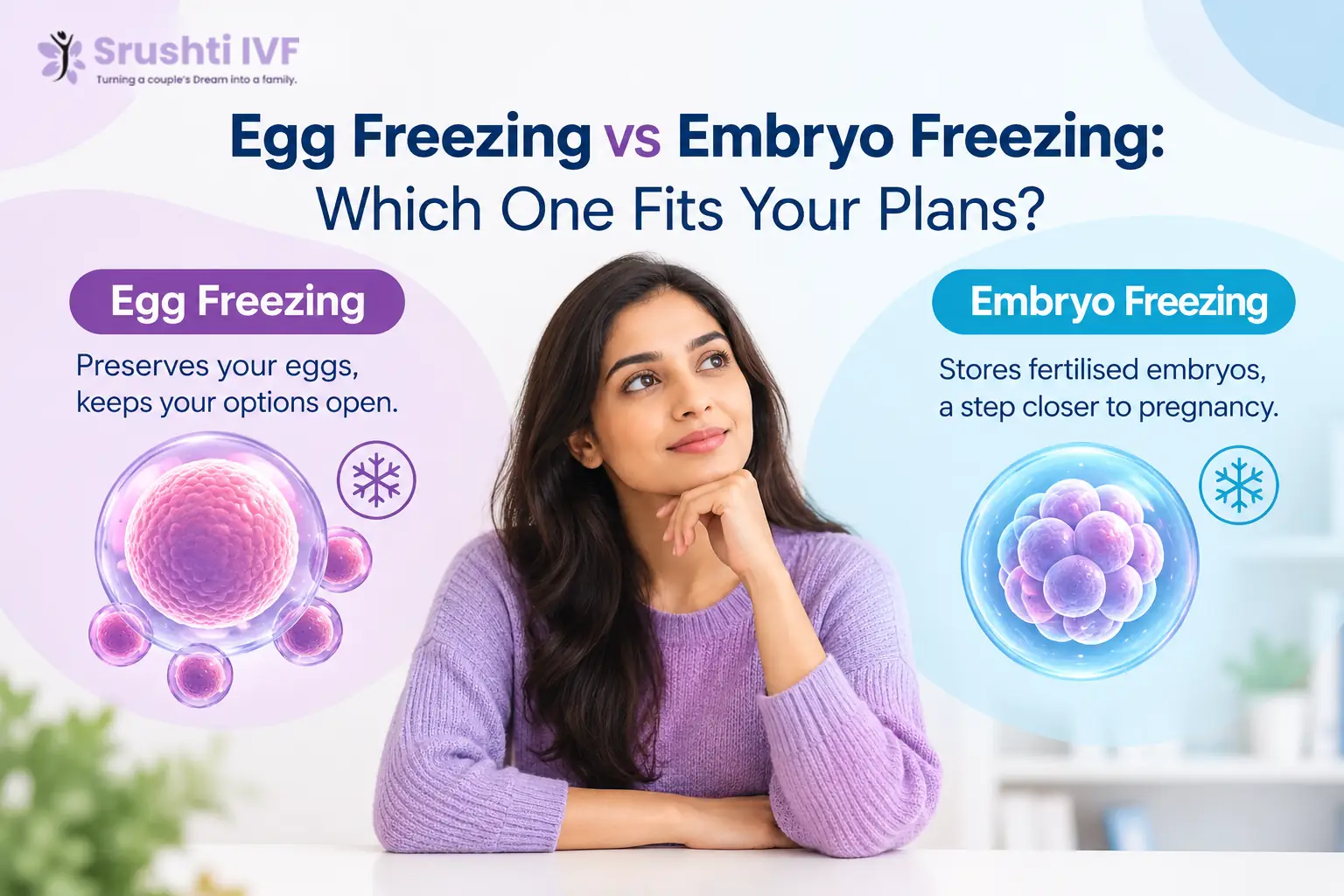
egg freezing stores your unfertilised eggs, so the decision about sperm stays open. Embryo freezing fertilises the eggs first and stores the embryos that develop, so that decision is already made. Almost every other difference flows from that one point.
If you are weighing up IVF Treatment in PCMC, this guide walks you through both procedures, who tends to choose which, the risks that should never be glossed over and the questions worth asking before you commit to anything.
At Srushti Hospital and IVF Center in Thergaon, Pimpri-Chinchwad, Dr. Nikhil A. Mahadar offers gynaecological and fertility consultations that start with your history and goals, not with a procedure.
What Is Egg Freezing, in Plain Terms?
Egg freezing, known medically as oocyte cryopreservation, means collecting mature eggs from your ovaries and freezing them exactly as they are. No sperm, no fertilisation, no embryos. Just your eggs, paused in time.
When you decide you are ready for pregnancy, those eggs can be thawed, fertilised in the laboratory and grown into embryos. A suitable embryo can then be transferred into the uterus.
Think of it as keeping your options open rather than committing to a plan. That is exactly why it appeals to women who are not yet ready to start a family, as well as to those who need to protect their fertility before a medical treatment that could affect the ovaries.
Key takeaway: Egg freezing preserves eggs only. Every decision about fertilisation waits until later.
How Does Egg Freezing Actually Work?
The process takes roughly two to three weeks from the first injection to the day of retrieval. Here is what happens at each stage.
1. The first conversation
Your doctor will want to know your age, menstrual history, medical conditions, current medications and what you are hoping to achieve. Expect an honest discussion about what the procedure can and cannot do, and what it is likely to cost.
2. Checking your ovarian reserve
A blood test for anti-Müllerian hormone (AMH) and an ultrasound to count antral follicles give a rough picture of how your ovaries may respond to stimulation. These tests are useful planning tools. They cannot tell you exactly how many eggs will be collected and they cannot predict whether you will conceive later.
3. Stimulating the ovaries
For around 10 to 12 days you take fertility medication, usually by injection, to encourage several follicles to grow in a single cycle instead of the usual one. Your doctor tracks progress with ultrasound scans and may adjust the dose along the way.
4. Retrieving the eggs
Once the follicles are mature, a trigger injection is given and retrieval is scheduled roughly 34 to 36 hours later. Under sedation or anaesthesia, a fine needle guided by ultrasound passes through the vaginal wall to collect the eggs. Most women go home the same day.
5. Freezing and storage
Mature eggs are frozen using vitrification, a rapid cooling technique that limits ice-crystal damage. They are then stored in liquid nitrogen until you need them.
6. Using them later
When the time comes, the eggs are thawed and fertilised, most often using intracytoplasmic sperm injection (ICSI), where a single sperm is injected directly into each egg. The embryos that develop are assessed before one is chosen for transfer.
Key takeaway: Egg freezing is a short, intense process. The waiting part is entirely up to you.
Who Usually Chooses Egg Freezing?
Egg freezing tends to come up in conversations with women who:
- Want to delay pregnancy for career, education, financial or relationship reasons.
- Are about to start cancer treatment or another medical therapy that could reduce ovarian function.
- Have a condition such as endometriosis or a family history of early menopause that may affect their egg supply over time.
- Are not ready to decide about sperm, whether from a partner or a donor.
- Have been advised by a doctor to consider fertility preservation.
Age matters here more than most people expect. Eggs frozen in the late twenties or early thirties tend to carry better reproductive potential than eggs frozen later. That does not mean a woman of 38 should not consider it. It means the conversation about numbers and expectations needs to be more detailed.
Key takeaway: Egg freezing is not a guarantee. Some eggs will not survive thawing, some will not fertilise and some embryos will not grow. Going in with clear eyes is part of the process.
What Is Embryo Freezing?
Embryo freezing takes the same first steps as egg freezing, then adds one more. After retrieval, the eggs are fertilised with sperm in the laboratory. The embryos that develop over the following days are assessed, and those that reach a suitable stage are frozen.
This usually happens around day three of development or at the blastocyst stage on day five or six, depending on how the embryos are growing and what your treatment plan calls for.
When you are ready for pregnancy, a frozen embryo is thawed and transferred into the uterus during a planned frozen embryo transfer cycle. There is no need to repeat stimulation or retrieval unless the stored embryos run out.
Key takeaway: Embryo freezing stores a fertilised, developing embryo. The sperm question has already been answered.
How Does the Embryo Freezing Process Differ?
Most of the steps overlap with egg freezing. The differences appear after retrieval.
1. Evaluating both partners
Because sperm is involved from the start, the doctor assesses the egg provider and the sperm provider. That may include ultrasound, hormone tests and semen analysis.
2. Stimulation and monitoring
Identical to egg freezing. Medication encourages multiple follicles to grow and ultrasound tracks their progress.
3. Egg retrieval
Also identical. Mature eggs are collected under ultrasound guidance and handed to the embryology team.
4. Fertilisation
Eggs are combined with prepared sperm using conventional IVF or ICSI, depending on sperm quality and clinical judgement. The laboratory then watches the embryos develop day by day.
5. Assessment and freezing
Not every fertilised egg becomes an embryo worth freezing. Those that develop well are vitrified and stored.
6. Frozen embryo transfer
When you are ready, your uterus is prepared, often with hormonal support, and a thawed embryo is placed through the cervix using a thin catheter. A pregnancy test follows at the time your treating team recommends.
Key takeaway: The extra step of fertilisation gives you information about embryo development before freezing, something egg freezing cannot offer.
Who Usually Chooses Embryo Freezing?
Embryo freezing is more common among:
- Couples already going through IVF who have more good embryos than they need for one transfer.
- Patients who need to delay transfer because of a medical issue, a thin uterine lining or a risk of ovarian hyperstimulation.
- People who have settled the sperm question, whether with a partner or a donor, where legally and clinically appropriate.
- Anyone whose treatment plan involves a freeze-all cycle followed by a later transfer.
Embryo freezing also raises questions that egg freezing does not. What happens to the embryos if the relationship ends? If one partner changes their mind? If storage fees go unpaid? These are uncomfortable to discuss, which is precisely why they should be discussed before treatment, not after.
Key takeaway: Embryo freezing is a shared decision with shared consequences. Consent paperwork is not a formality.
Egg Freezing vs Embryo Freezing: What Are the Real Differences?
Set side by side, the distinctions come down to a handful of points.
- What is frozen: Egg freezing stores unfertilised eggs. Embryo freezing stores fertilised eggs that have developed into embryos.
- When fertilisation happens: After thawing for eggs. Before freezing for embryos.
- Sperm needed at the time of freezing: No for eggs. Yes for embryos.
- What you learn before freezing: With eggs, only maturity. With embryos, how they actually develop over several days.
- Flexibility: Egg freezing keeps the fertilisation decision open. Embryo freezing closes it.
- Where things can go wrong: Eggs may not survive thawing, may not fertilise or may not develop. Embryos may not survive thawing, may not implant or may not lead to pregnancy.
- Storage and consent: Eggs belong to one person. Embryos usually involve two, which adds legal and emotional layers.
Neither route is automatically better. Age, ovarian reserve, medical history, sperm availability, relationship status, budget and personal values all weigh in.
Which Is Better for You? Five Questions to Ask Yourself
Patients often want a straight answer to “eggs or embryos?” The honest reply is that it depends on your answers to the following.
1. How old are you right now?
Egg quality and the rate of chromosomal abnormalities change with age. Freezing earlier generally preserves eggs with better average potential, though the number of eggs collected matters as much as the age at which they were collected. If you are in your late thirties, the conversation may shift towards how many cycles might be needed to store a meaningful number.
2. What does your ovarian reserve look like?
AMH and antral follicle count estimate how your ovaries may respond. If the expected yield is low, your doctor may raise the possibility of more than one stimulation cycle. That affects cost, time and emotional load, so it is worth knowing early.
3. Are you ready to create embryos?
This is the heart of the decision. If you want to keep the sperm question open, egg freezing fits. If you have already answered it and want the extra information that embryo development provides, embryo freezing fits. Neither should be rushed to please a partner, a parent or a timeline.
4. What does the sperm picture look like?
Sperm quality influences fertilisation and embryo growth. A semen analysis before embryo freezing helps the doctor decide between conventional IVF and ICSI. ICSI is a tool for specific situations, not a default upgrade.
5. Is there a medical clock running?
If you are facing chemotherapy, radiotherapy, major pelvic surgery or a condition that affects ovarian function, timing is everything. In these cases the fertility specialist usually works alongside your oncologist or treating physician to fit preservation into the treatment window.
Key takeaway: The right choice is the one that matches your circumstances today, with eyes open about what might change tomorrow.
Where Does IVF Fit Into All of This?
IVF is the laboratory process that brings eggs and sperm together to form embryos. Embryo freezing is part of an IVF cycle by definition. Egg freezing uses the first half of an IVF cycle, then stops before fertilisation.
The full IVF pathway, for context:
Step 1: Consultation and testing. Medical history, cycle history, previous treatments and reproductive goals. Tests may include AMH, other hormone levels, ultrasound with antral follicle count and semen analysis. Not everyone needs every test.
Step 2: Ovarian stimulation. Medication to grow multiple follicles, with scans to monitor response.
Step 3: Egg retrieval. Trigger injection, then collection roughly 34 to 36 hours later under sedation.
Step 4: The fork in the road. For egg freezing, mature eggs are vitrified straight away. For embryo freezing, eggs are fertilised and the embryos are grown and assessed before freezing.
Step 5: Future treatment. Frozen eggs are thawed and fertilised. Frozen embryos are thawed and transferred. Your doctor decides the next steps based on embryo development, uterine assessment and your overall health.
What Is Vitrification and Why Does It Matter?
Older slow-freezing methods cooled cells gradually, which allowed ice crystals to form and damage delicate structures inside the egg or embryo. Vitrification cools cells so rapidly, using protective solutions, that water turns glass-like without forming crystals.
Survival rates after thawing improved markedly once vitrification became standard practice. It is now the usual method for both eggs and embryos.
That said, the technique is only part of the equation. Egg and embryo quality, laboratory skill, how carefully freezing and thawing protocols are followed and your individual clinical picture all shape the outcome. When you visit a centre, ask how their laboratory handles cryopreservation and how they track and identify stored material.
Key takeaway: Vitrification is the reason modern egg freezing is viable at all. Ask any centre you visit to explain their process.
What Are the Benefits of Egg Freezing?
You keep the fertilisation decision for later. No partner, no donor, no commitment at this stage.
You preserve eggs at today’s age, not tomorrow’s. Egg freezing does not stop ageing elsewhere in the body, and it cannot promise a pregnancy, but it does hold the eggs at the age they were collected.
It fits around medical treatment. For women about to undergo therapy that could harm the ovaries, egg freezing offers a way to protect future options, provided there is enough time before treatment begins.
It feeds directly into IVF later. Frozen eggs can be used in a future IVF cycle. How well that goes depends on age at freezing, number of mature eggs stored and how fertilisation and development unfold.
What Are the Benefits of Embryo Freezing?
You know more before you freeze. Embryos have already shown they can develop over several days, which gives you information that frozen eggs cannot.
You may avoid another stimulation cycle. If frozen embryos are available, a future transfer can go ahead without repeating injections and retrieval.
It supports a freeze-all strategy. When a fresh transfer is not advisable, perhaps because of hyperstimulation risk or an unprepared uterine lining, freezing everything and transferring later is often the safer plan.
It allows transfers to be spaced. Couples hoping for more than one child can return for later transfers from the same cycle, if enough suitable embryos were stored.
What Are the Risks and Limitations Nobody Should Skip Over?
Both procedures are well established. Both still carry risks and both have limits that deserve plain language.
Side effects of stimulation. Bloating, abdominal discomfort, headaches, mood swings and soreness at injection sites are common and temporary. A smaller number of patients develop ovarian hyperstimulation syndrome (OHSS), where the ovaries over-respond. Mild cases settle with rest. Severe cases need urgent care. Careful dosing and monitoring reduce the risk but do not eliminate it.
Risks of retrieval. Egg retrieval is a minor procedure, but it is still a procedure. Bleeding, infection and injury to nearby organs are possible, though uncommon. Ask about anaesthesia arrangements and what to watch for during recovery.
No promises about pregnancy. This is the hardest part. Freezing eggs or embryos does not guarantee a baby. Eggs may not survive thawing. Fertilisation may fail. Embryos may stop developing. A transferred embryo may not implant. Age, egg and sperm quality, uterine health and plain chance all play a part.
Money and emotion. Fertility preservation involves repeated visits, medication, laboratory fees and ongoing storage charges. The uncertainty can weigh heavily, particularly when stored eggs or embryos are used years later and the outcome is not what was hoped. Ask for the full itemised cost before you begin, and ask what support is available along the way.
Key takeaway: A good fertility consultation spends as much time on what could go wrong as on what could go right.
Does Egg Freezing Guarantee a Pregnancy Later?
No. It cannot.
What egg freezing does is preserve eggs for potential future use. Whether those eggs lead to a pregnancy depends on your age when they were collected, how many mature eggs were stored, how many survive thawing, whether they fertilise, how the embryos develop and whether the uterus is ready to receive one.
Any success estimate a clinic gives you should come with context: your age, your test results and the number of eggs stored. A percentage without that context is marketing, not medicine.
Does Embryo Freezing Improve IVF Success?
Not automatically, and not for everyone.
The purpose of embryo freezing is to preserve embryos that can be transferred later. For some patients a frozen transfer is preferable to a fresh one, particularly when the ovaries have been heavily stimulated or when the uterine lining needs time to recover. In those situations a frozen transfer can be the better clinical choice.
But the chance of pregnancy still rests on embryo quality, age-related factors and uterine health. Your doctor should be able to explain, in your specific case, why a fresh or a frozen transfer is being recommended.
How Much Do Egg Freezing and Embryo Freezing Cost in Pune?
There is no single price, and any clinic that quotes one without examining you is leaving things out.
Egg freezing costs usually cover: consultation, investigations, stimulation medication, monitoring scans, egg retrieval, laboratory freezing and storage.
Embryo freezing costs usually cover: the IVF cycle, retrieval, sperm preparation, fertilisation, embryo culture, freezing and storage. A later frozen embryo transfer is typically billed separately.
If you are comparing centres for IVF Treatment in Pune, ask for an itemised estimate rather than reacting to an advertised starting figure. Check whether medication, laboratory charges, annual storage, thawing and future transfer are included or added later. Two quotes that look very different on paper sometimes end up close once everything is counted.
Prices change with your needs and with the services a centre offers. Contact the centre directly for current figures.
How Do You Choose an IVF Centre for Fertility Preservation?
Location and price matter, but they should not be the only filters. If you are searching for an IVF Center in PCMC, run each option through these questions.
Is the assessment personal? The doctor should review your history, goals and test results before suggesting a pathway, not hand you a package on the first visit.
Is the laboratory transparent? Ask which laboratory performs the freezing, how eggs and embryos are stored and identified, what monitoring systems are in place and what happens if you later want to move your stored material elsewhere.
Are the limits discussed honestly? A responsible consultation covers the possibility that not every egg fertilises, not every embryo develops and treatment may not result in pregnancy.
Are the costs itemised? Consultation, medication, monitoring, retrieval, laboratory work, freezing, storage and future treatment should all be on the sheet.
Is there someone to call afterwards? You will have questions in the days and weeks after retrieval. Find out who answers them.
Fertility Consultation at Srushti Hospital and IVF Center
If you are considering fertility preservation, or simply want to understand your options before deciding anything, a consultation is the sensible first step.
A Srushti Hospital and IVF Center in PCMC, offers gynaecological and fertility consultations with Dr. Nikhil A. Mahadar, who brings 17 years of clinical experience and fellowship training in laparoscopic surgery and infertility.
Patients exploring IVF Treatment in PCMC can use the consultation to discuss:
- Whether egg freezing or embryo freezing is relevant to their situation.
- Which tests make sense before treatment.
- How age and ovarian reserve may shape the options.
- Realistic risks, limitations and timelines.
- Laboratory, freezing and storage arrangements.
- Estimated costs for the procedure and for any future treatment.
A Gynecologist in PCMC can assess your reproductive health and explain the next steps in the context of your own history. If you are looking for a Gynecologist in Pune for fertility guidance, choose someone who talks about limitations as readily as benefits.
The availability of specific egg-freezing, embryo-freezing, laboratory and storage services should be confirmed directly with the centre before making a treatment decision.
Frequently Asked Questions About Egg and Embryo Freezing
Can I freeze my eggs without fertilising them?
Yes. That is what egg freezing is. Mature eggs are stored unfertilised and can be thawed and fertilised later as part of a future treatment cycle.
Can I freeze embryos if I am not ready for pregnancy yet?
Yes. Embryos created through IVF can be stored for future use. Because embryo creation involves sperm, consent and storage agreements, those discussions should happen before treatment begins.
How long can frozen eggs and embryos be stored?
Under proper cryogenic conditions, for many years. The permitted duration, renewal process and consent rules depend on applicable regulations and the centre’s policies. Ask your centre what currently applies.
Is egg freezing painful?
Stimulation injections and the bloating that follows can be uncomfortable but are usually manageable. Retrieval is done under sedation or anaesthesia, so the procedure itself is not felt. Some cramping or soreness afterwards is normal. Your doctor will tell you what recovery should look like and when to call.
Is embryo freezing safer than egg freezing?
Neither is universally safer. Both involve the same stimulation and retrieval steps and therefore the same procedural risks. The differences lie in what is stored and what decisions are made beforehand, not in the safety profile.
Do I need a partner to freeze my eggs?
No. Egg freezing does not involve fertilisation, so no sperm is needed at the time of storage. Embryo freezing does require sperm, from a partner or a donor where legally and clinically appropriate.
Can I use frozen eggs if I decide to have a baby years from now?
Potentially, yes. Frozen eggs can be thawed and used in a future IVF cycle. Success is not guaranteed and depends heavily on your age at the time of freezing and the number and quality of eggs stored.
Which option is better for future family planning?
It depends on your age, ovarian reserve, relationship situation, sperm availability, medical history and personal values. A consultation is the right place to work through those factors.
Where can I enquire about fertility treatment in PCMC?
Contact Srushti Hospital and IVF Center in Thergaon to book a consultation with Dr. Nikhil A. Mahadar and confirm which assessment and treatment services are currently available.
Conclusion: Decide With Information, Not Pressure
Egg freezing keeps your eggs and keeps your options open. Embryo freezing creates and stores embryos and asks you to make the sperm decision now. Both can be the right call. Neither comes with a guarantee.
Before choosing, weigh your age, your ovarian reserve, your family plans, your medical history, the full cost and how you feel about making the fertilisation decision today rather than later.
If fertility preservation is on your mind, or if you are researching IVF Treatment in PCMC more broadly, speak to a specialist who will walk through your individual picture before recommending anything.
Contact Srushti Hospital and IVF Center for a fertility consultation
Doctor: Dr. Nikhil A. Mahadar
Address: Shop No. 19, 19A, 20, Ground Floor, Metropole Building, Dange Chowk Road, opposite Runwal Heritage, Thergaon, Pimpri-Chinchwad, Maharashtra 411033
Phone: 07028340149 / 7798019692
Email: info@srushtiivf.com
Clinic hours: Monday to Saturday, 6:30 PM to 9:30 PM
Morning consultations: 9:00 AM to 11:00 AM, Monday to Sunday, by appointment